Contact Us

Contact Us

Guangzhou Huaisheng Packaging Co.,Ltd.
We provide customers with quality products and provide high-quality services.
If you would like to leave us a comment please go to contact us
+86-18122240089

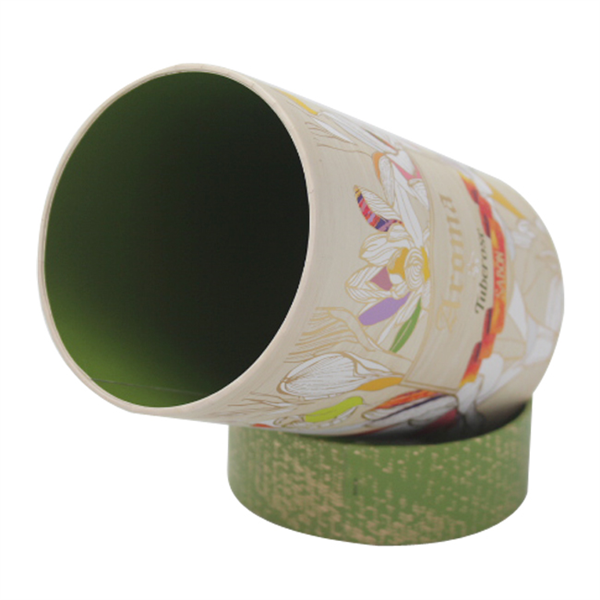
Cylinder perfume boxes (round tubes) combine strong physical protection, striking shelf appeal and efficient logistics. Factories typically produce them by selecting the right paperboard, printing and finishing flat materials, forming the tube via spiral-winding or rolling, adding end caps or lids, inserting protective inners, and performing rigorous QC. When correctly engineered, cylinder perfume boxes deliver premium unboxing experiences while remaining cost-effective for medium to large runs.
Packaging is a strategic part of perfume value: according to Statista, the global packaging market remains in the hundreds of billions USD and continues to grow as brands invest in premium presentation. Perfume is a luxury and gifting category where packaging drives first impressions and repeat purchase. (Source: Statista — global packaging market overview). Industry design publications (The Dieline, Packaging Digest) also highlight that structural novelty—like cylindrical tubes—ranks highly for visual differentiation in 2024–25 design trends.
Before we go step-by-step, here are three common cylinder perfume packaging approaches you’ll encounter—ranked by Brand/Luxury, Protection, and Cost:
Spiral-wound paperboard tubes (classic cardboard tube)
Pros: Strong longitudinal strength, excellent roundness, cost-efficient in medium/large volumes, recyclable.
Cons: Surface may need extra finishing for luxury look; tooling for caps may be required.
Ranking: Protection ★★★★☆, Brand ★★★☆☆, Cost ★★★★☆.
Common when brands want sustainable, sturdy tubes. (See spiral winding explanation).
Rolled laminated tube with printed outer sleeve
Pros: Highly customizable print wrap, can create seamless luxury visuals; good for limited editions.
Cons: Slightly higher cost, requires precise lamination to avoid seams.
Ranking: Brand ★★★★☆, Protection ★★★★☆, Cost ★★★☆☆.
Rigid round telescopic tubes (two-piece rigid boxes shaped as cylinder)
Pros: Premium tactile feel (rigid board), strong shelf presence, accepts foils/emboss.
Cons: Most expensive; heavier to ship.
Ranking: Brand ★★★★★, Protection ★★★★☆, Cost ★★☆☆☆.
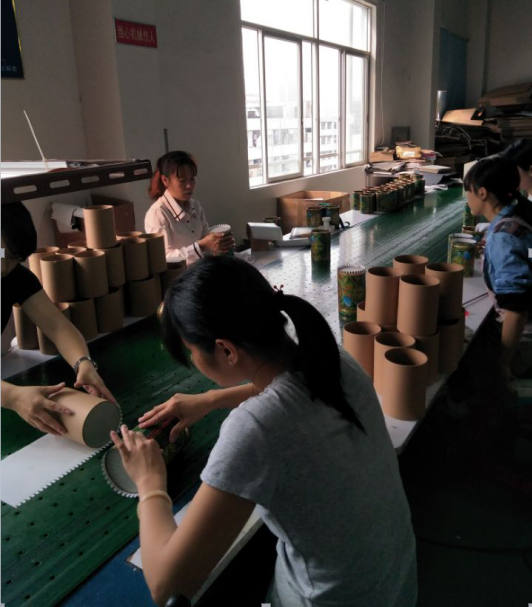
Below is the typical end-to-end factory workflow, simplified into actionable steps so you can follow how a cylinder tube is manufactured.
Factory engineers start with the product specs: bottle diameter, height, cap type, and any accessories (funnel, sample vial). They create a structural dieline and 3D mockups to confirm internal clearance, lid fit, and where inner supports will sit.
Choice depends on needed strength and finish. Spiral tubes usually use multiple layers of kraft or high-density paperboard; rigid telescopic cylinders use thicker greyboard (rigid chipboard). Material decisions affect GSM, rigidity, and recyclability.
Graphics teams prepare print files (Pantone or CMYK) and preflight artwork. Factories produce color proofs to check Pantone matching and registration — this prevents costly color shifts in volume runs. For luxury finishes, decisions on foil stamping, embossing, spot UV or soft-touch lamination are finalized here.
There are two common forming methods:
Spiral winding: narrow paperboard ribbons are spirally wound on a mandrel with adhesive; this builds wall thickness and excellent roundness. Ideal for mailing tubes and robust cylindrical packaging.
Convolute/rolled lamination: sheets are wrapped longitudinally and glued, often used for high-graphic wraps and seamless appearance.
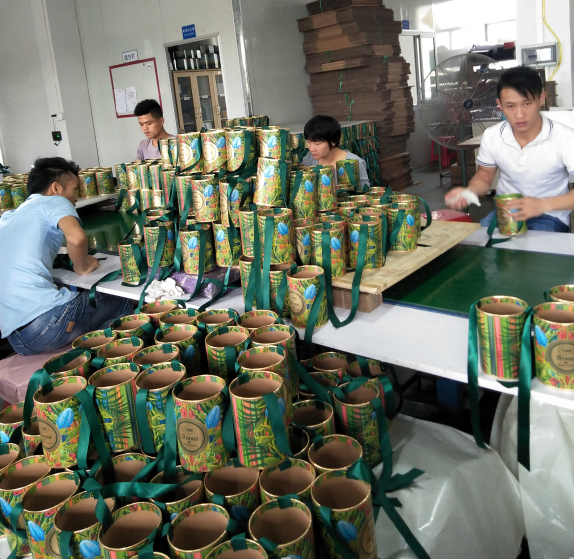
The continuous tube is cut to length, trimmed, and left to cure so adhesives fully set. Precision cutting ensures consistent diameter and clean ends.
Factories produce or source end caps (cardboard discs, metal/plastic caps, or foam inserts). For perfume bottles, custom die-cut inserts (paperboard or foam) cradle the bottle, preventing movement during transit.
Printed tubes may receive varnish, lamination, foil stamping or embossing. For premium runs, factories add sleeves or magnetic closures to the tube ends. Final assembly involves inserting the bottle & accessories and closing the tube.
QC includes dimensional checks, print inspection, drop and compression tests (especially for exported goods). After passing QC, items are flat-packed (if applicable) or packed into master cartons for shipping.
Materials vs finishes: Paperboard material weight and special finishes (foil, soft touch) typically drive the largest cost changes. Industry reports show packaging finishes can add 10–25% to unit costs depending on coverage. (Packaging industry reports, 2024–25).
Sustainability: Paper tubes are widely recyclable; spiral wound tubes often use kraft papers with high recycled content, aiding ESG claims. The U.S. EPA and Sustainable Packaging Coalition note rising consumer preference for recyclable packaging—brands frequently accept small cost premiums for sustainable materials.
| Priority | Spiral-wound tube | Laminated wrap tube | Rigid telescopic tube |
|---|---|---|---|
| Best for protection | ★★★★ | ★★★ | ★★★ |
| Best for premium look | ★★ | ★★★★ | ★★★★★ |
| Best for sustainability | ★★★★★ | ★★★ | ★★ |
| Best for unit cost | ★★★★★ | ★★★★ | ★★ |
Q1: Are cylinder perfume boxes recyclable?
A1: Yes — if made from single-material paperboard (kraft or paperboard) and without plastic liners. Spiral-wound kraft tubes are typically recyclable.
Q2: What is the minimum order quantity (MOQ) for cylinder tubes?
A2: MOQs vary by factory and process. Spiral winding often supports moderate MOQs (1,000–5,000), while highly finished rigid telescopic tubes require larger runs.
Q3: How long does production take?
A3: Typical lead time is 2–6 weeks depending on complexity, finishes, and sampling rounds.
Q4: Can cylindrical boxes have magnetic closures?
A4: Yes — factories can embed small magnets into end caps or lids; this raises cost but enhances perceived luxury.
Q5: How to test cylinder packaging for shipping?
A5: Use drop testing, compression testing and vibration tests per ISTA protocols; also check fit under temperature/humidity ranges for long shipments.