Contact Us

Contact Us

Guangzhou Huaisheng Packaging Co.,Ltd.
We provide customers with quality products and provide high-quality services.
If you would like to leave us a comment please go to contact us
+86-18122240089


Sustainable chocolate packaging isn’t just a trend in 2025—it's quickly becoming a global standard. With governments tightening packaging regulations and consumers demanding eco-friendly alternatives, chocolate brands of all sizes are shifting toward recyclable, compostable, and low-impact packaging solutions. In this guide, you’ll learn what sustainable chocolate packaging really means, which materials are the most effective, how to choose the right eco-friendly chocolate box, and what future trends will shape the industry.
In simple terms, sustainable chocolate packaging refers to materials and packaging structures that reduce environmental impact throughout their entire lifecycle—from sourcing to production, disposal, and recycling.
A sustainable chocolate box typically aligns with three principles:
Responsibly sourced materials (e.g., FSC-certified paper)
Low environmental impact during production
High recyclability, compostability, or reusability
Regulations reinforce these standards.
For example, the EU Packaging and Packaging Waste Regulation (PPWR) now pushes food brands to adopt recyclable mono-material solutions. Meanwhile, the ISO 18606 standard defines what qualifies as compostable packaging.
This means that a modern sustainable chocolate gift box must meet both environmental and food safety requirements—especially important when you’re dealing with products like chocolate that are sensitive to temperature, moisture, and contamination.
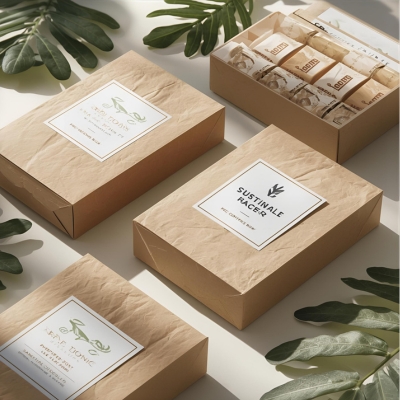
Consumers are increasingly prioritizing low-impact products:
74% of global consumers say they are willing to pay more for sustainable packaging (Source: McKinsey, 2024)
The chocolate industry generates over 2.2 million tons of packaging waste every year, much of which is plastic (Source: UNEP Plastic Pollution Report, 2023)
Governments across Europe, the U.S., and Asia are mandating recyclable packaging by 2030
For chocolate brands—especially those selling boxed chocolates, holiday chocolate gifts, or luxury assortments—adopting eco packaging is no longer optional. It’s a competitive advantage.
Below are the most widely used materials in 2025 for eco chocolate boxes, chocolate wrappers, and chocolate gift box sets.
100% recyclable
Low cost
Natural brown aesthetic
Perfect for: everyday chocolate packaging, bars, and small chocolate snacks
Downside: Lower moisture barrier unless paired with a thin biodegradable lining.
These premium boxes are widely used in high-end chocolate gift sets.
Advantages:
Strong structure
Recyclable
Luxury presentation
Downside:
Heavier and more expensive than kraft boxes
Cellulose (wood-pulp-based) and PLA (corn-based) films are major alternatives to traditional plastic wrappers.
However, true compostability depends on industrial composting facilities, not home conditions.
Used when chocolates need a high barrier against oxygen and humidity.
Eco benefit: Less virgin plastic in circulation.
Extremely durable
Long-lasting
Great for premium holiday chocolate gift boxes
Downside: Higher production cost.
| Rank | Packaging Type | Sustainability Score | Pros | Cons | Best For |
|---|---|---|---|---|---|
| #1 | Kraft Paper Box | ★★★★★ | Fully recyclable, cost-effective | Low barrier | Basic chocolate packaging |
| #2 | FSC Rigid Gift Box | ★★★★☆ | Luxury appearance, recyclable | Higher cost | Premium chocolate gift box |
| #3 | Cellulose/PLA Film | ★★★★☆ | Compostable, plastic-free | Requires industrial composting | Individual chocolate wrappers |
| #4 | Recycled PET Liners | ★★★☆☆ | Recyclable, food-safe barrier | Not plastic-free | Moisture-sensitive chocolates |
| #5 | Metal Tin Box | ★★★☆☆ | Reusable, long life cycle | Expensive | Holiday gift sets |
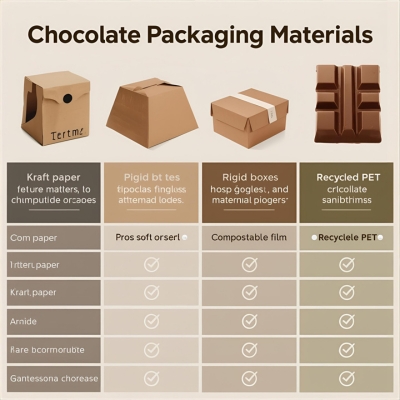
Does your chocolate melt easily?
Does it need strong moisture or oxygen protection?
Dark chocolate, for example, requires less barrier protection than fragile truffles.
If you sell artisanal chocolate → kraft chocolate packaging box
If you sell luxury holiday gift sets → rigid recyclable chocolate gift box
If you export → choose packaging that meets EU and FDA requirements
Look for:
FSC / PEFC certification
EU Food Contact Compliance
FDA 21 CFR safety requirements
Single-material packaging improves recycling rates dramatically.
(Ellen MacArthur Foundation recommends this approach in their Circular Economy mission.)
Soy-based inks
Water-based varnish
Low-VOC adhesives
These prevent contamination risk and improve recyclability.
Uses fully recyclable paper and actively promotes supply-chain transparency.
Shifted from plastic trays to molded paper inserts.
Introduced paper-based holiday chocolate wrappers that reduce plastic by up to 40% (Source: Lindt Sustainability Report, 2024).
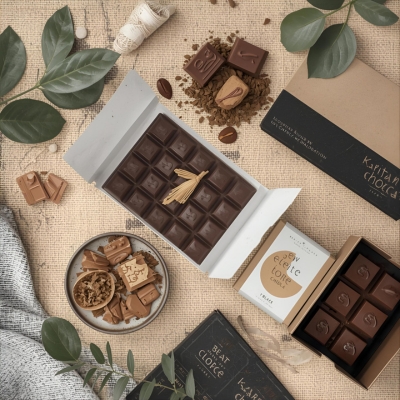
The chocolate industry is moving toward:
Plastic-free chocolate wrappers
Mono-material paper chocolate boxes
Reusable chocolate tins
Zero-waste luxury packaging
Digital traceability for packaging materials
By 2030, nearly all chocolate packaging will be required to be easily recyclable under new EU and U.S. standards.
Materials must be recyclable, compostable, or reusable and produced with low environmental impact.
Yes—when paired with food-grade lining that meets FDA or EU food contact standards.
They reduce fossil-fuel plastic use, but true biodegradation requires industrial composting.
Recycled paper cannot touch food directly unless it meets food-grade safety standards. Most brands add a thin protective liner.
For premium brands: FSC rigid boxes
For everyday use: kraft chocolate packaging box