Contact Us

Contact Us

Guangzhou Huaisheng Packaging Co.,Ltd.
We provide customers with quality products and provide high-quality services.
If you would like to leave us a comment please go to contact us
+86-18122240089


A typical empty cardboard box weighs between 0.2 lb (≈90 g) for a small folding carton and 6 lb (≈2.7 kg) for a large corrugated box. The exact weight depends on material type, wall thickness, and box size. Understanding how much a box weighs is crucial for accurate shipping cost estimation, product safety, and sustainable packaging design.
In this guide, we’ll explain how box weight is calculated, compare common box types, and show you how to make smart packaging decisions that balance strength, branding, and cost.
Packaging weight directly affects shipping cost and environmental impact. According to Grand View Research (2024), the paper packaging market reached USD 397.5 billion in 2024, growing steadily with e-commerce expansion(grandviewresearch.com).
At the same time, 72% of U.S. consumers say that packaging design influences their purchasing decisions.
Carriers also enforce strict limits: USPS allows up to 70 lb per package, and UPS/FedEx apply dimensional weight pricing.
Thus, even small differences in shipping box weight can lead to major cost changes.
| Rank | Box Type | Advantages | Disadvantages | Typical Empty Weight |
|---|---|---|---|---|
| #1 Corrugated Shipping Box | Strong, durable, ideal for transport and storage. | Heavier than paperboard, less premium finish. | Small: 0.5–2 lb; Large: 2–6 lb | |
| #2 Folding Carton (Paperboard) | Lightweight, print-friendly, cost-effective. | Limited protection for heavy goods. | 0.2–0.8 lb | |
| #3 Rigid / Drawer Gift Box | Premium appearance, ideal for luxury gifting. | Highest unit weight and cost. | 0.6–3 lb |
Summary:
For shipping durability, corrugated ranks #1.
For retail display, folding carton ranks #2.
For luxury unboxing, rigid boxes rank #3.
These rankings help businesses select packaging that matches logistics and brand priorities.
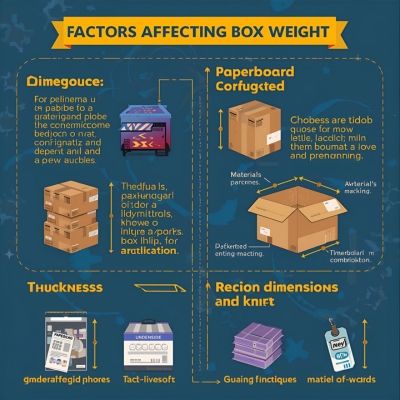
Determine whether the box is single-wall, double-wall, or triple-wall corrugated; folding carton; or rigid board.
The Fibre Box Association (FBA) provides technical details on linerboard weights and flute grades.
Flatten the box and measure its total square footage. You’ll use this to multiply by the paper’s basis weight (lb/1000 ft²) or GSM (g/m²).
Multiply area × GSM (or convert using basis weight). For corrugated, add both liner and medium weights. Online tools like Neenah Paper’s Paper Math Calculator simplify this step.
Lamination, foils, or inserts add extra grams. Always include coatings, handles, magnets, or ribbons when calculating total weight.
Finally, weigh a real sample on a scale. Manufacturer data often gives close estimates, but real measurement ensures accurate shipping costs and compliance.
| Box Type | Dimensions (inches) | Approx. Weight | Use Case |
|---|---|---|---|
| Small corrugated mailer | 8 × 6 × 4 | 0.6 lb (270 g) | Jewelry, cosmetics |
| Standard shipping box | 12 × 12 × 12 | 1.5 lb (680 g) | Electronics, retail |
| Large double-wall box | 24 × 18 × 18 | 4–5 lb (2 kg) | Bulk shipments |
| Folding carton | 8 × 5 × 3 | 0.3 lb (136 g) | Cookies, candles |
| Magnetic rigid gift box | 10 × 8 × 4 | 1.2 lb (544 g) | Premium packaging |
Optimize flute selection:
Use E- or B-flute corrugated for lighter yet strong construction.
Lightweight responsibly:
Use high-strength linerboards instead of thicker ones to cut grams.
Right-size packaging:
Avoid oversized boxes to minimize void fill and shipping fees.
Choose sustainable materials:
Recycled liners and kraft paper reduce both weight and carbon footprint.
Partner with experienced suppliers:
Work with reliable custom packaging box manufacturers (like HS Packaging) who can balance strength and lightness.
According to the EPA (2024), paper and paperboard containers account for over 28% of packaging waste in U.S. municipal solid waste streams. Lightweighting initiatives help reduce transport emissions and landfill waste.
Choosing the right cardboard box weight not only lowers freight cost but also contributes to your brand’s sustainability goals.
Q1: How much does a standard 12×12×12-inch box weigh?
A 1: Most single-wall boxes of that size weigh between 1–2 lb; double-wall versions are 3–4 lb. Always confirm with your box supplier.
Q2: What affects a box’s total weight the most?
A 2: Material density, wall layers, finishing (lamination, coating), and inserts all influence total mass.
Q3: How do shipping carriers calculate charges?
A 3: Carriers use whichever is greater — actual or dimensional weight. For example, UPS and USPS charge higher rates for bulky yet light boxes.
Q4: Is heavier packaging always better?
A 4: Not necessarily. Over-engineering increases cost and emissions. Choose materials based on product fragility and logistics needs.
Q5: How can I accurately estimate before production?
A 5: Use supplier specifications or online calculators like Neenah’s; then validate with a prototype scale test for precision.
Knowing how much a box weighs isn’t trivial—it’s a strategic factor that affects cost, efficiency, and brand image. By measuring carefully, selecting the right material, and validating with prototypes, businesses can optimize their packaging systems for performance and sustainability.
For expert consultation on lightweight yet durable custom packaging boxes, contact HS Packaging, your reliable B2B partner for innovative packaging solutions.