Contact Us

Contact Us

Guangzhou Huaisheng Packaging Co.,Ltd.
We provide customers with quality products and provide high-quality services.
If you would like to leave us a comment please go to contact us
+86-18122240089

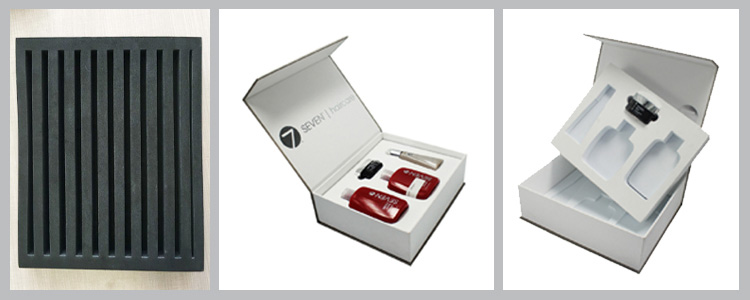
The insert is where protection actually happens. It holds the product in place, defines how the product is displayed, and often decides whether the box feels premium. Yet many buyers specify the outer box carefully and treat the insert as an afterthought. Comparing insert materials early avoids cost surprises and disappointing samples.
This article is written for brands choosing inserts for cosmetics, electronics, jewelry, bottles, and gift sets, and for buyers who need to balance protection, appearance, and sustainability claims.
The first problem is picking by look alone. A velvet-lined foam insert looks luxurious but may be harder to describe as recyclable, while a paper insert is easier to recycle but may need careful design to hold a heavy item. The second problem is fit: an insert that is too loose lets the product move, while one that is too tight is hard to remove.
Buyers also overlook tooling. Die-cut foam and EVA require cutting dies or molds, while molded pulp needs a mold. These cost more up front, so quantity and number of SKUs matter when choosing a material.
The target buyer includes cosmetics and fragrance brands, electronics makers, jewelry and watch brands, wine and spirits sellers, and corporate gift suppliers. A cosmetic brand may choose EVA or flocked trays, an electronics brand may choose foam or pulp for shock absorption, and an eco-focused brand may choose paper.
When a brand sells several SKUs in the same outer box, a modular insert system can reduce tooling and inventory, with different inserts for different products.
Before choosing, confirm product weight, fragility, and shape, the display look you want, the sustainability claims you plan to make, and the quantity per SKU. Provide a physical sample so the cavity can be matched to the actual product, including caps and accessories.
A complete RFQ should ask the factory to quote two or three insert options side by side, with tooling cost, unit cost, and lead time. Request samples of each and test them for fit, protection, and ease of packing.
EVA is firm, clean-cut, and available in colors, which suits cosmetics and accessories. Foam offers the highest shock absorption and is common for electronics and fragile goods. Paper and paperboard inserts are recyclable, printable, and economical, and corrugated inserts add strength. Plastic trays offer precise shapes and visibility but are harder to align with plastic-reduction goals.
Combine materials when it helps. A paper base with a thin lining can protect and look premium, while a corrugated divider can hold bottles apart. Always test with drop and transit simulation before approving bulk production.
The following internal links can be used inside the article body or at the end of the article to guide visitors toward relevant product pages:
Request a comparison rather than a single quote, and decide on the criteria in advance: protection, appearance, recyclability, and unit cost. Test the insert with the real product and the final packaging, not in isolation.
Huaisheng offers EVA, foam, paper, corrugated, and plastic inserts, and can recommend a combination for your product. Share a product sample and quantity and we will propose options.
Foam generally absorbs the most shock, but the right choice depends on the product and the claims you want to make.
Paper and corrugated inserts are usually easier to recycle than foam, EVA, or plastic, but check local rules.
Many do; die-cut and molded inserts need dies or molds, so volume and SKU count affect cost.
Insert material is a design decision, not an afterthought. Buyers who compare options against protection, look, recyclability, and cost choose better and avoid rework. The next step is to share a product sample and quantity for an insert comparison.