Contact Us

Contact Us

Guangzhou Huaisheng Packaging Co.,Ltd.
We provide customers with quality products and provide high-quality services.
If you would like to leave us a comment please go to contact us
+86-18122240089


Choosing the right packaging box is not just a design decision—it directly affects cost, logistics, sustainability, and customer experience. For brands deciding between a flat paper box and a rigid box, the question often comes down to function vs. perception.
Rigid boxes are known for their premium look and strong structure, while flat paper boxes offer flexibility, efficiency, and scalability. But when exactly should you choose a flat paper box instead of a rigid box? This guide breaks it down from a packaging manufacturer’s perspective.
Before comparing use cases, it’s important to clarify what these two packaging types actually are.
A flat paper box (also called a folding box or collapsible box) is delivered flat and assembled when needed. It is usually made from cardboard, paperboard, or corrugated paper.
A rigid box, on the other hand, is pre-assembled and made from thick greyboard wrapped with printed paper. It holds its shape permanently and cannot be folded flat.
Both have their place—but not in the same scenarios.
One of the biggest reasons brands choose flat paper boxes is cost control.
Flat paper boxes generally cost 30–60% less than rigid boxes due to:
Lower material usage
Simpler production processes
Reduced manual labor
Faster production cycles
For brands working with tight margins—such as footwear, cosmetics, electronics accessories, or promotional products—a flat paper box allows professional packaging without inflating unit costs.
Rigid boxes, while premium, often make sense only when the packaging itself is part of the product’s perceived value.
Flat paper boxes are shipped and stored flat-packed, which dramatically reduces logistics costs.
Saves warehouse space
Reduces international shipping volume
Lowers freight costs (especially for ocean shipping)
Easier inventory management
For brands selling online or shipping globally, this advantage is hard to ignore. Many e-commerce brands actively avoid rigid boxes simply because they are inefficient to transport.
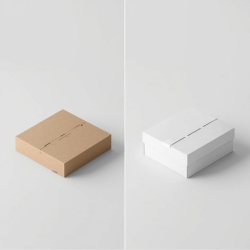
Flat paper boxes usually have shorter production lead times compared to rigid boxes.
Typical timelines:
Flat paper box: 7–15 days
Rigid box: 20–30 days
Why? Rigid boxes require:
Board cutting
Manual box forming
Wrapping and drying time
Flat boxes rely more on automated die-cutting and folding, making them ideal for seasonal campaigns, promotions, or urgent launches.
If sustainability is part of your brand story, flat paper boxes often align better.
Flat paper boxes:
Use less material
Are easier to recycle
Often qualify for FSC-certified paper
Generate lower carbon emissions during transport
Rigid boxes, while recyclable, typically use mixed materials and adhesives that complicate recycling processes.
Many modern brands choose flat paper packaging to support eco-friendly and minimal packaging strategies.
Not every product needs luxury packaging.
Flat paper boxes are ideal when:
The product already has strong branding
Packaging is meant to protect, not impress
The unboxing experience is secondary
Customers value simplicity and usability
Common applications include:
Shoe boxes
Apparel packaging
Subscription boxes
Electronics accessories
Retail display packaging
Rigid boxes work best for gift-driven or high-emotion purchases, not everyday products.
Flat paper boxes offer more flexibility when scaling production.
They are easier to customize with:
Multiple sizes
Different structures
Variable printing designs
Shorter MOQ options
For growing brands that frequently adjust SKUs or test markets, flat paper boxes provide lower risk and higher adaptability.
Flat paper boxes are especially suitable for e-commerce brands.
They:
Fit better into shipping cartons
Reduce dimensional weight charges
Are less likely to be damaged during transport
Can be reinforced with corrugated structures
Rigid boxes often require secondary protective packaging, increasing total shipping cost.
Flat paper boxes are not always the right answer.
You should still consider a rigid box if:
The product is a luxury or gift item
Packaging is part of the brand experience
The box is reused or displayed
Price point supports higher packaging costs
Examples include:
Jewelry
Perfume
High-end gift sets
Limited edition products
A professional packaging manufacturer will not push one solution blindly. Instead, they evaluate:
Product weight and size
Target market positioning
Budget constraints
Shipping method
Sustainability goals
Many brands even combine both solutions—using flat paper boxes for mass sales and rigid boxes for premium editions.
Yes. With proper material thickness and structure design, flat paper boxes can provide excellent protection for most consumer products.
Not necessarily. High-quality printing, finishes, and structural design can make flat paper boxes look professional and premium.
Absolutely. Sizes, printing, finishes, and structures are highly customizable.
They are recyclable, but often less eco-friendly due to mixed materials and adhesives.
Choosing between a flat paper box and a rigid box is about strategy, not status.
If your brand values:
Cost efficiency
Logistics optimization
Sustainability
Scalability
A flat paper box is often the smarter choice.
Rigid boxes still have their place—but flat paper boxes are increasingly becoming the preferred packaging solution for modern, growth-focused brands.