Contact Us

Contact Us

Guangzhou Huaisheng Packaging Co.,Ltd.
We provide customers with quality products and provide high-quality services.
If you would like to leave us a comment please go to contact us
+86-18122240089

Christmas packaging is the one category where a perfect box that arrives late is worth nothing. The product is tied to a fixed retail window, and every step between concept and shelf competes with the same crowded factory calendars and shipping lanes that every other holiday buyer is also trying to book. Procurement for seasonal gift boxes is therefore a scheduling exercise first and a design exercise second.
This article is written for retailers, beauty and food brands, e-commerce sellers, and corporate gifting teams who buy holiday gift boxes in bulk and need a realistic Q4 timeline before they commit to a design.
The most common problem is starting from the creative brief instead of the calendar. Teams spend weeks on artwork, then discover that sampling, approval, production, and sea freight together need more time than remains before the in-store date. A second problem is changing the structure late, for example adding an insert or a second SKU, which resets tooling and sampling and silently moves every later milestone.
Buyers also underestimate the shipping leg. Holiday freight rates and container availability tighten in autumn, and a box that is finished on schedule can still miss the window if it waits for space. Finally, many first-time buyers treat the Christmas order as a one-off, which makes it harder to negotiate reorder pricing or reserve production slots for a mid-season top-up.
The target buyer includes retail chains and boutiques stocking holiday collections, beauty and gourmet food brands launching limited editions, e-commerce brands building festive bundles, and corporate teams ordering client gifts. A retailer cares about shelf presentation and unit cost at volume, an e-commerce brand cares about flat shipping and unboxing, and a corporate buyer cares about consistent branding across hundreds of recipients.
Because holiday demand is hard to predict, many buyers split the order into a committed base quantity and a smaller reserve that can be reordered quickly. Deciding that split early gives the factory a realistic picture of what to plan and what to hold in reserve.
Before sampling, confirm the box structure (rigid, folding, magnetic, or drawer), board and wrap material, festive finishing such as foil, embossing, or spot UV, insert or tray layout, and the exact in-store or delivery date. Lock the dimensions with the real product, not a mock-up, since a late size change is the most expensive mistake in this category.
A complete RFQ should also include order quantity and any reserve quantity, destination port, preferred freight method, packing requirements for the export carton, and whether the box ships flat or assembled. Ask the factory to quote lead time as separate steps: dieline approval, sample, bulk production, and packing, so the calendar can be checked line by line.
Festive designs often rely on metallic foil, glossy spot UV, and deep embossing, all of which add production passes. Decide which finishes carry the design and which are decoration, then simplify the rest. A strong two-finish design usually delivers more impact and fewer schedule risks than a box that uses every available finish.
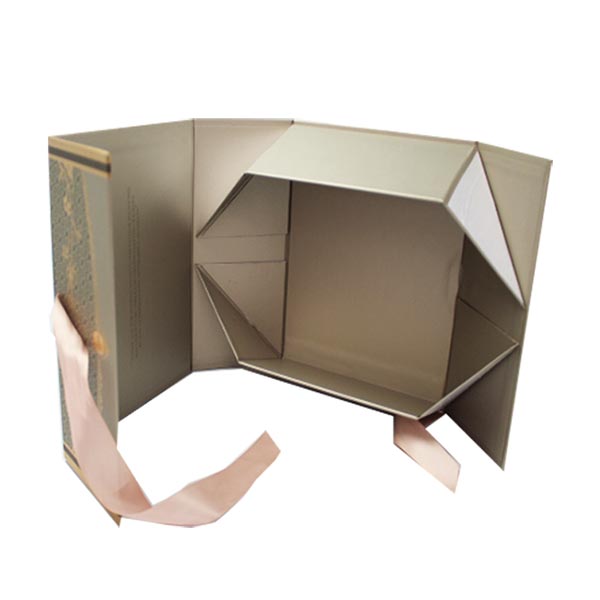
If the box will be reused as a keepsake, invest in a sturdier structure such as a magnetic rigid box. If it is a single-season giveaway, a well-finished folding box can cut both unit cost and freight volume. Either way, test the closure and the insert with the real product before approving bulk production.
The following internal links can be used inside the article body or at the end of the article to guide visitors toward relevant product pages:
Work backward from the date the goods must be on shelf. Subtract the sea or air transit time, then the packing and customs buffer, then bulk production, then sampling and approval, and finally design. The date you land on is the real deadline for confirming the order, and it is usually earlier than the brief assumes.
Huaisheng is a direct factory in Guangzhou, close to the port of Huangpu, with in-house printing, die-cutting, and assembly, and typically replies to inquiries with a quote within 24 hours. That integration shortens the number of handoffs in a tight calendar, and early quotation lets buyers reserve production capacity before the seasonal rush.
As a rule, buyers should confirm well before the production rush and work backward from the in-store date, allowing for sampling, bulk production, packing, and freight, with extra buffer for approvals.
Yes, if the structure is neutral and the festive elements live in the artwork or a removable sleeve or ribbon, the same tooling can serve several seasons.
Place a committed base order and agree a reserve quantity and lead time in advance so a top-up can be produced quickly if sales exceed forecast.
Christmas gift box wholesale rewards buyers who treat the calendar as the main specification. When structure, finishes, and quantities are locked early and the timeline is checked step by step, the box arrives on time and on brief. The most useful next step is to share your in-store date, product dimensions, and target quantity so the schedule can be tested before artwork is finalized.