Contact Us

Contact Us

Guangzhou Huaisheng Packaging Co.,Ltd.
We provide customers with quality products and provide high-quality services.
If you would like to leave us a comment please go to contact us
+86-18122240089

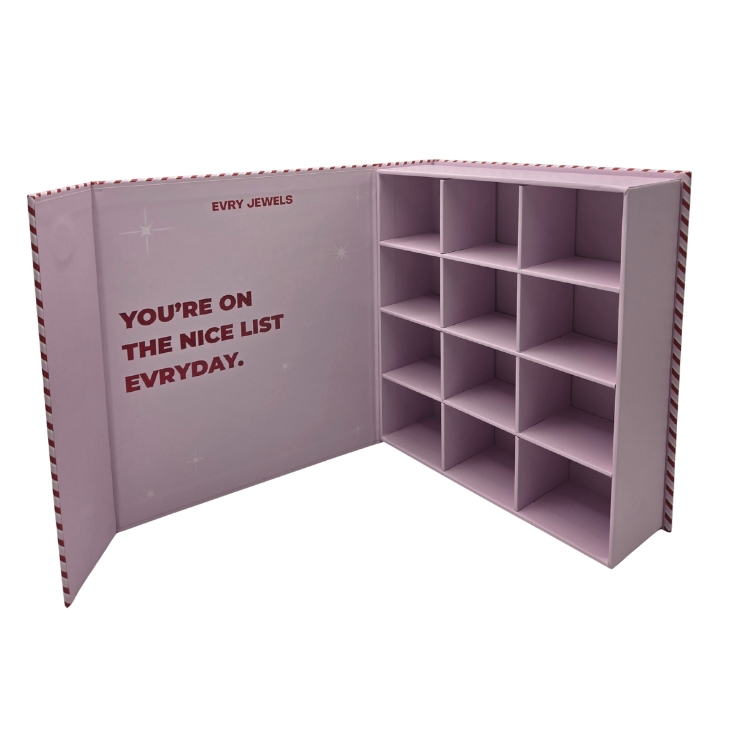
An advent calendar box is one of the more structurally complex gift formats a brand can order: instead of one cavity, it typically needs 12 to 25 individual doors or compartments, each holding a separate small item, all within a single die-cut structure that still needs to look cohesive and premium when closed. Procurement here is really a multi-cavity engineering project with a hard, non-negotiable seasonal deadline.
This article is written for beauty, food and beverage, and gifting brands sourcing seasonal countdown packaging for Christmas, product launches, or promotional campaigns.
The first problem is finalizing the number and size of compartments too late, after outer box artwork is already in development, which forces a costly structural redesign. The second problem is underestimating door mechanism reliability at scale — a door that opens smoothly on a hand-finished sample can tear or jam across a full production run if the die-cutting and scoring are not precise.
Buyers also frequently discover that advent calendar orders have an unusually rigid deadline, since the product is useless if it arrives after the countdown period begins, which leaves little room for delays in sampling or production.
The target buyer includes beauty and skincare brands releasing seasonal countdown sets, food and beverage brands (chocolate, tea, coffee) with a holiday gifting angle, and general gifting or subscription brands running a seasonal promotional campaign. Each should confirm compartment count and item dimensions early, since these drive the entire structural design.
Because this format is almost always tied to a fixed calendar date, buyers should treat the production and shipping timeline as the primary planning constraint from the very first inquiry, not an afterthought.
Before sampling, buyers should confirm the number of doors or compartments, the dimensions and weight of each item going inside, door mechanism style (perforated tear-open, hinged flap, or drawer), and overall box structure (flat panel, house shape, or book style). These parameters should be locked before exterior artwork begins.
A complete RFQ should include the full item list with dimensions for each compartment, target delivery date (working backward from the countdown start date), and order quantity. Buyers should request that the factory confirm door mechanism reliability through a full production-representative sample, not a hand-cut prototype.
Door or flap scoring needs to be precise and consistent across the full sheet, since a compartment that tears unevenly or fails to stay closed undermines the product's core function. Compartment sizes often vary across the calendar (larger doors for bigger items near the end of the countdown), which adds structural complexity compared to a uniform-grid layout.
Given the fixed seasonal deadline, buyers should build in extra time for a full structural sample review before committing to bulk production, since a late-discovered mechanism issue leaves little room to recover before the sales window closes.
The following internal links can be used inside the article body or at the end of the article to guide visitors toward relevant product pages:
Buyers should finalize the complete item list and compartment count before any exterior design work begins, since this is the detail most likely to force a costly late-stage revision. Given the fixed seasonal deadline, starting the sourcing process well ahead of the target countdown date is essential, with extra buffer built in for structural sample review.
Huaisheng produces multi-compartment advent calendar structures and tests door mechanism reliability using production-representative samples before bulk manufacturing. We recommend confirming the full item list and target delivery date as early as possible for this category specifically.
Structures commonly range from 12 to 25 compartments, though the exact count depends on the campaign and should be confirmed before structural design begins.
Precisely scored perforated or hinged doors tend to perform more consistently across a full production run than intricate custom mechanisms; the factory should confirm reliability with a production-representative sample.
Given the fixed countdown start date, we recommend starting the sourcing process well ahead of the season, with extra buffer time for structural sampling before committing to bulk production.
Advent calendar gift box sourcing is a structural engineering project with a fixed seasonal deadline, and success depends on locking the item list and compartment design early while allowing enough time for reliable door mechanism testing. Buyers who plan backward from the countdown start date avoid the most common failure in this category: a beautiful design that arrives too late or does not survive full-scale production. The recommended next step is sharing your full item list and target countdown start date for a structure and timeline proposal.